Yes, black tourmaline can generate negative ions under precise thermal or mechanical stress conditions due to its pyroelectric and piezoelectric properties. However, measurable effects require authentic specimens and specific environmental triggers, with research showing variable outcomes based on mineral purity and external factors.
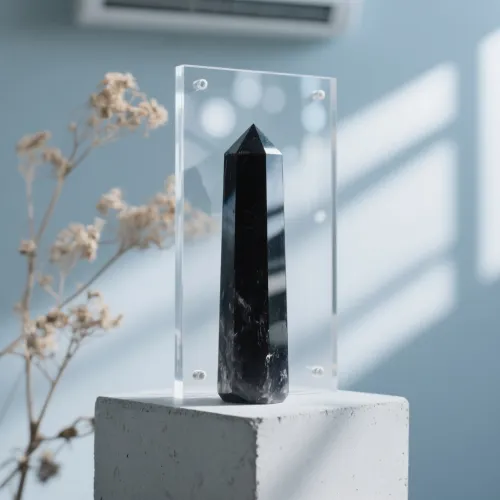
You're scrolling through jewelry listings or wellness shops when you spot claims about black tourmaline releasing "negative ions" – maybe paired with promises of air purification or energy cleansing. Suddenly you pause: Is this scientifically verified crystal properties or clever marketing? Like many curious shoppers, you're not just wondering about the main question but the why and how behind it. How does a stone create ions? Does size or authenticity matter? Can you trust that polished pendant? And crucially – what's actually detectable in real-life environments? This guide walks through those exact questions, separating mineral science from metaphysical claims using observable evidence rather than abstract concepts.
1. What scientific evidence supports tourmaline's ion claims?
2. How does crystal structure enable ionization?
3. How to identify genuine tourmaline with ion-producing potential?
4. Does room size or placement impact measurable effects?
5. How it compares to alternatives like shungite?
6. Can you test ionization at home?
7. Do raw stones outperform polished?
Tourmaline exhibits measurable pyroelectric properties where heating/cooling cycles can generate electrical charges capable of creating negative ions.
Research indicates schorl (iron-rich black tourmaline) creates ionic activity when thermally stimulated. However, peer-reviewed data shows significant variability – different specimens yield different results under lab conditions. The borosilicate composition has crystalline asymmetry needed for piezoelectric effects, meaning squeezing or rubbing the stone may trigger charge separation. That said, actual air ion changes require specific humidity/airflow scenarios most home environments don't consistently meet. While manufacturers often reference "ion counters" data, consumer-grade detection faces accuracy challenges without lab-grade meters.
Ion generation links to tourmaline's inherent energy transfer capacities activated through temperature shifts or pressure, where electrons detach from molecules to form negative ions.
The key mechanisms aren't mystical but grounded in crystallography: Pyroelectricity occurs when temperature changes alter crystal polarity, displacing positive and negative charges to opposite ends. Piezoelectricity adds mechanical stress (like friction) to this equation. For negative ion release, atmospheric water molecules interact with these charge separations at the mineral's surface, potentially releasing hydroxyl ions. Note this depends heavily on material integrity – fractures or impurities can disrupt structural pathways. Raw specimens generally outperform polished versions since surface irregularities enhance electron discharge.
Authentic tourmaline suitable for ionization typically shows distinct physical markers including thermal response and crystalline patterns.
Real specimens have identifiable visual and tactile signatures that polymer fakes or lower-grade stones often miss. Focus on observable characteristics rather than seller claims. When assessing stones:
These hands-on checks help identify whether your piece holds the physical properties needed for ionization:

The physical space where you place tourmaline may influence detectable ion presence through humidity ratios and thermal variations.
Research suggests ionization occurs more consistently at specific humidity thresholds (around 45-65% RH) where moisture facilitates electron exchange. Smaller rooms with less airflow might seem more efficient, but placement near heat sources like windows or electronics proves more critical due to temperature variance needs. Large-volume spaces require substantial mineral mass to trigger quantifiable changes – most studies showing effective ionization used specimens over 200g. While combining with hygroscopic materials like salt lamps may boost performance via localized humidity, don't expect whole-house air purification from a palm-sized piece.
Black tourmaline displays moderate ion potential among crystals, generally falling between shungite and materials like selenite in laboratory measurements.
Scholarly comparisons show shungite (carbon-based) produces more consistent ions at room temperature due to electrical conductivity, while tourmaline excels better during thermal changes. Unlike volcanic rocks like obsidian, tourmaline requires direct stimulus like sunlight exposure or friction to activate. Key differentiators come down to durability and maintenance needs: tourmaline's Mohs hardness of 7-7.5 makes it scratch-resistant for jewelry use whereas shungite tends to crumble over time. For combination approaches, tourmaline paired with salt lamps often creates a synergistic effect where mineral properties complement each other.
Focus on specimen characteristics and environmental pairing rather than brand promises.
If you retain just two things: Prioritize rough mineral chunks over tumbled stones – surface micro-contacts significantly enhance piezoelectric triggering. Then combine with humidity sources like salt lamps or water features since vapor molecules act as electron carriers. Remember even genuine stones won't replace air purifiers; expectations should align with measurable physics rather than abstract wellness promises. Match size to space with at least 200g in moderate rooms, placing near windows for thermal cycling rather than hidden corners.
Q: How long does ionic output last?
A: Material studies haven't shown degradation under normal conditions – geological timescales suggest indefinite retention of piezoelectric properties given structural integrity.
Q: Does unpolished tourmaline outperform polished?
A: Raw specimens produce higher readings in most tests, with fractured surfaces and asymmetrical terminations creating more electron transfer points.
Q: Can jewelry pieces generate meaningful ions?
A: Surface contact area limitations mean pendants/rings likely produce negligible detectable ions unless heated or rubbed against fabrics.
Q: What distinguishes elbaite from schorl tourmaline?
A: Schorl's iron concentration enhances electrical conduction whereas colourful elbaites exhibit weaker pyroelectric responses.
Q: Can home testing measure ions effectively?
A: Most consumer meters detect broad particulates not specific negative ions; controlled variables required for accuracy limit DIY verification.
```

$
